Link Telescope

In addition to Ham Radio, I also am interested in astronomy.  I you look me up on QRZ.com you will see that I live on Observatory Road.  Our road has this name because there is a real observatory on the road.  The observatory was constructed in 1937 by Dr. Goethe Link an Indianapolis surgeon and avid amateur astronomer.  The telescope was constructed from a 36″ mirror blank built by Corning Glass as a test blank for the 200″ Mount Palomar telescope (http://www.astro.caltech.edu/palomar/).  
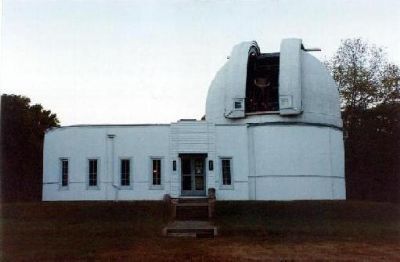
Goethe Link Telescope Martinsville, Indiana

Goethe Link Telescope
Martinsville, Indiana


The Link Observatory is owned by Indiana University but is cared for by the Indianapolis Astronomical Society.

This summer my wife and I had the unique opportunity to be trained as operators for this telescope.  The German Equitorial mount used on the Link telescope is remarkably similar to the mount used on the Palomar telescope.
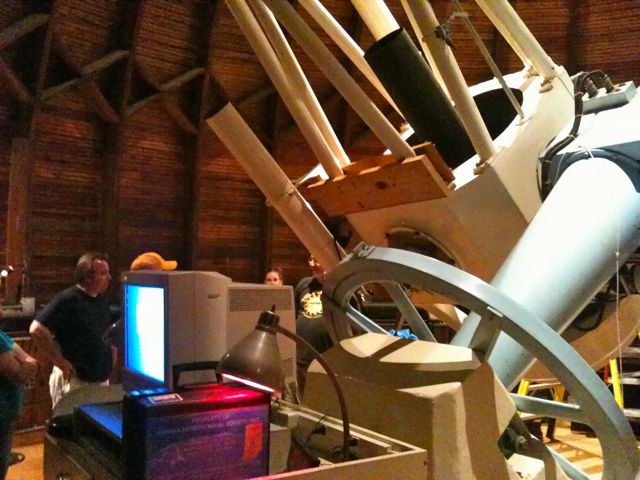
 

Link Telescope German Equatorial Mount

Link Telescope German Equatorial Mount

Operating the scope is a lot of fun and a very interesting experience.  It can be very disorienting looking up through the dome as it is being rotated to a new location.  One of the most exciting observations we made during our training was to see Pluto.  

The telescope is no longer used for research because the local light pollution has limited its usefulness for research.  However, it is still a wonderful telescope for observational astronomy.  The telescope is now receiving new life as the Link Observatory Space Science Center.

Laura and I have had several opportunities to operate the telescope for public outreach programs and for groups of astronomy students from Indiana University.  It is really an amazing machine.

73,

Fred
Astronomy Picture of the Day

In addition to ham radio I am also interested in Astronomy.  During some our recent astronomy club meetings and outings I have noticed that there are a large number of astronomy enthusiasts that are also hams.  Maybe that means that the two hobbies attract the same sorts participants; those with an interest in technical things.  I think the same was true during the early days of the personal computer revolution.

Anyway, for you hams that are also interested in Astronomy, here is a great link to bookmark.  The NASA photo of the day is a good way to start the morning along with your cup of joe and a quick peek at the DX Spotting Network.

http://apod.nasa.gov/apod/astropix.html

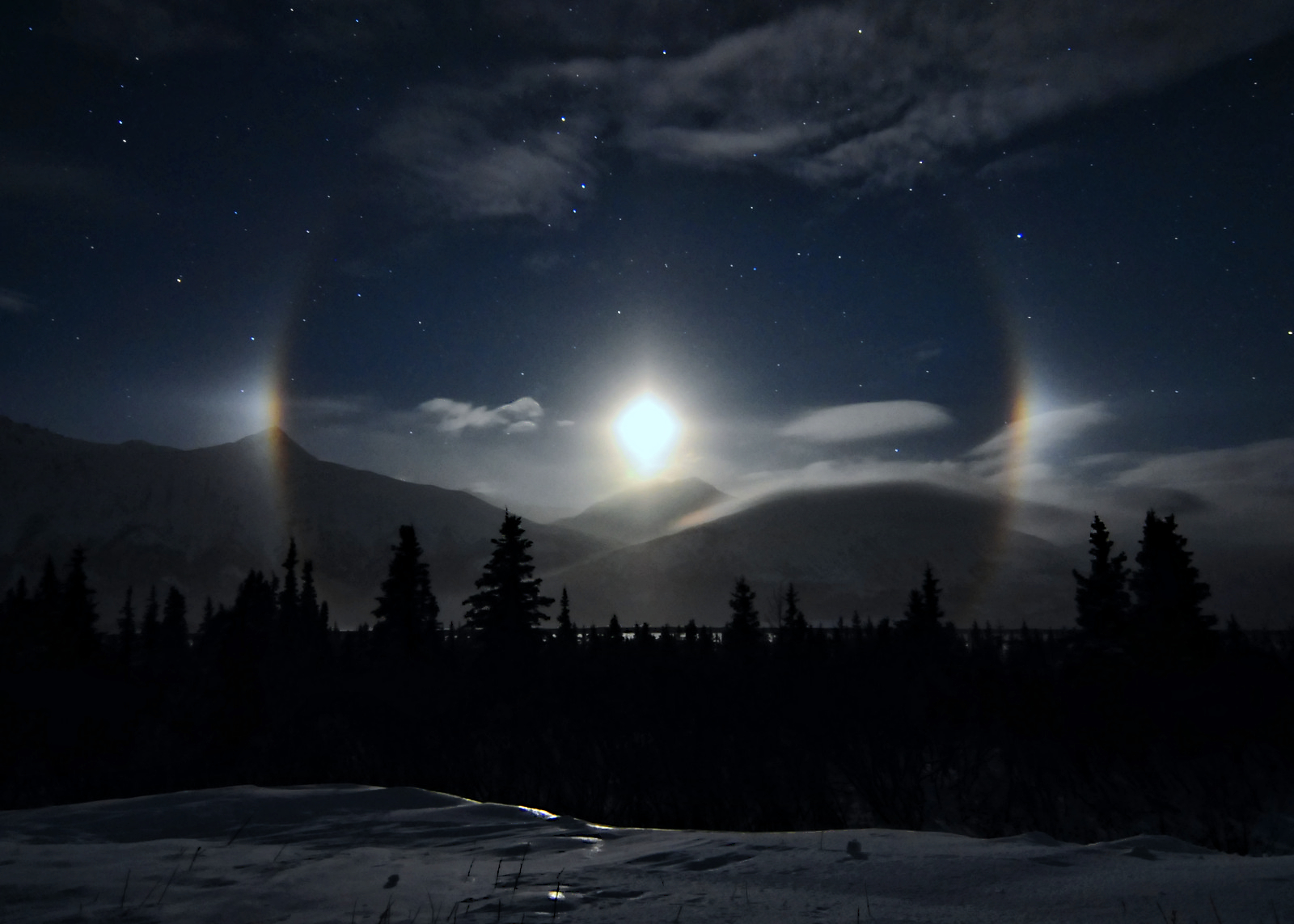
Here is todays photo:

See Explanation.  Clicking on the picture will download  the highest resolution version available.

Alaskan Moondogs
Image Credit & Copyright: Sebastian Saarloos
Explanation: Moonlight illuminates a snowy scene in this night land and skyscape made on January 17 from Lower Miller Creek, Alaska, USA. Overexposed near the mountainous western horizon is the first quarter Moon itself, surrounded by an icy halo and flanked left and right by moondogs. Sometimes called mock moons, a more scientific name for the luminous apparations is paraselenae (plural). Analogous to a sundog or parhelion, a paraselene is produced by moonlight refracted through thin, hexagonal, plate-shaped ice crystals in high cirrus clouds. As determined by the crystal geometry, paraselenae are seen at an angle of 22 degrees or more from the Moon. Compared to the bright lunar disk, paraselenae are faint and easier to spot when the Moon is low.